The codesign-cant programme tunes a small canted-rotor quadrotor's frame and controller together in simulation. The previous step found that the designs retrained for a 45° tilt-command limit lose 31 of 640 held-out flights, and that every one of those losses comes from the 0.5 m start offset each test flight begins with. Turn everything else off (wind, turbulence, sensor noise, yaw steps) and keep only the offset: 28 crashes. Remove only the offset: none.
A loop that is stable near hover but crashes from a large start has a basin of attraction smaller than the test's start set. So this step measured the basin. Each flight's start offset was scaled along its own direction from 1 cm to 1 m per axis, twelve sizes, for ten designs and 64 held-out plants each, with the rest of the excitation off and then on. The predictions were committed before the code was written; three of six held, one more held in substance.
What came out
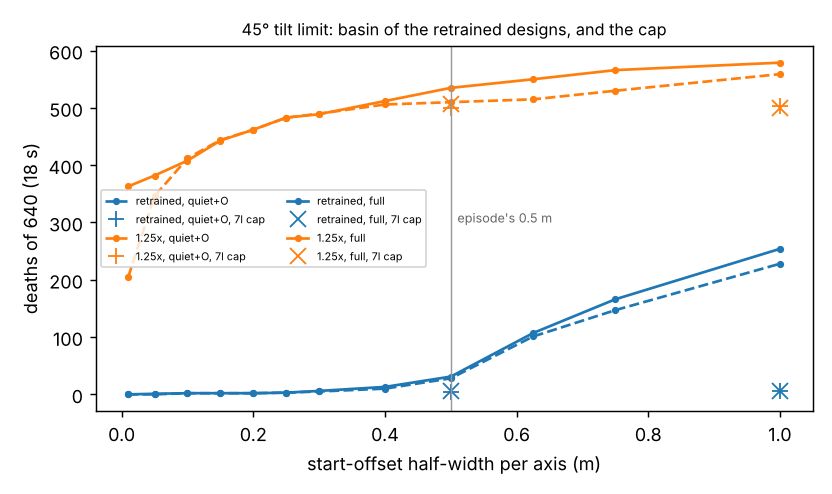
- The boundary is clean. Of 228 flights that crash somewhere on the grid, 227 crash at every larger offset. The smallest first lean that killed a flight asked for 4.7 m/s² for seven of the ten designs: about 0.47 m of position error at their gain of 10 s⁻².
- The test episode sits at the foot of the curve. Crashes go 10, 28, 101 and 228 of 640 at 0.4, 0.5, 0.62 and 1.0 m. A quarter more offset gives three and a half times the crashes. The 0.5 m figure is an inherited assumption, so the paper should report this curve rather than one point on it. I had predicted the episode sat at the basin's edge (median critical size 0.4-0.7 m); the measured median is 0.75 m.
- Capping the first lean removes the basin. Milestone 7l's cap limits the position loop's proportional request to 3.5 m/s². With it, crashes are 5 of 640 at 0.5 m and still 5 at 1.0 m (254 without it). The five left are marginal plants that already crash from 0.3 m, a different, small-signal problem. I had set a 90% bar at both sizes; the cap removed 84% at 0.5 m and 98% at 1.0 m.
- It does nothing for the over-tuned designs. Designs at 1.25× their integral-gain ceiling lose 535 flights uncapped and 506 capped. Theirs is the intrinsic limit cycle the describing function from two steps ago counts, and only the integral-gain margin fixes it.
One prediction could not be tested: whether the boundary is an acceleration or a distance. All ten retrained designs sit at the top of the position-gain box, so the two are the same number up to a constant. The designs from milestone 7l's widened box, whose gains run from 1.8 to 31.6, are where that question can be asked.
For a builder
A tune made for a 45° limit is safe from starts and waypoint steps that keep the first proportional request below about 4.7 m/s². With the 3.5 m/s² cap, the size of the step stops mattering. All of this is simulated, on one frame geometry, with 64 fixed start directions per design, so the 0.47 m is a median over those directions, not a guaranteed radius; a worst-direction search is the next step.
Data, code and the pre-registered predictions: experiments/m7al_roa/ and the programme's research log.