A codesign-cant run earlier today found that quadrotor designs retrained for a 45° tilt-command limit have a basin of attraction. Start them within about 0.47 m of their hover point and they recover. Start them further out and some tip past 60° and crash. That run offered a rule for builders: keep the first proportional request, position gain times error (kp · |e|), below about 4.7 m/s². But every design it tested had the same gain, kp ≈ 10 s⁻². A rule in m/s² and a rule in metres made the same predictions there, so it could not say which one was right. The difference matters: if the limit is a distance, a stiffer tune keeps its safe step; if it is an acceleration, the safe step shrinks with the gain.
The test
An earlier milestone (7l) had retrained 36 designs at a 45° limit. Twelve of them were given a wider gain box and chose kp 21.7 to 31.5; the other 24 sit at 10. We flew all 36 without the acceleration cap, scaling each of 64 held-out flights' start offset along its own direction from 1 cm to 1 m per axis (14 sizes, 18 s each), once with every other disturbance off and once with everything on. Five predictions were committed before the code was written, and all five held. The run took 179 s on four cores.
What it found
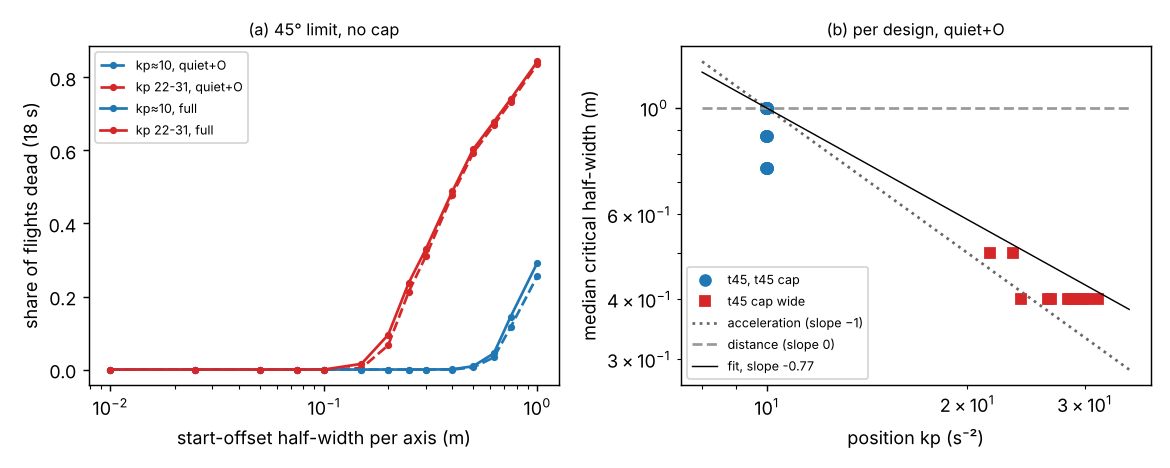
- The basin's edge is an acceleration. Pooled over 32,256 (design, flight, size) cases, kp · |e| separates crashes from survivors with an AUC of 0.985. The offset alone scores 0.910. Within a group of equal gains the two score the same, so the whole difference comes from the gain.
- The critical offset scales as 1/kp. Measured along each flight's direction, the per-design critical offset falls as kp to the power −1.06. The median request at which a flight first crashes is 7.40 m/s² at kp ≈ 10 and 7.01 m/s² at kp 22 to 31. The gain triples and the critical request moves by 5%.
- The 4.7 m/s² rule transfers, a little lower. Of 25,249 starts below 4.7 m/s², 26 crashed (0.1%). The smallest fatal request was 4.31 m/s².
- The cap removes all of it. Milestone 7l's cap bounds the same request at 3.5 m/s², below that floor. With it, the high-gain designs go from 463 crashes of 768 to 0 at a 0.5 m start, and from 648 to 0 at 1 m.
What a builder takes from it
For a tune at a 45° tilt limit, the safe takeoff or waypoint step is about 4.3 m/s² divided by the position gain: 0.43 m at kp 10, 0.14 m at kp 30. Or clip the proportional term so its request never passes about 3.5 m/s². A stress test that fixes the start offset in metres compares a soft tune at the foot of its curve with a stiff one past its edge, so the offset should be reported as a request.
Limits
This is one simulator. The designs come from one geometry pair, at lever 0, on one held-out seed of 64 flights each. The offsets run along 64 fixed directions, with no search for the worst one, and the grid brackets each critical value rather than solving it. The gain takes two clusters of values, not a continuum. The 45° limit, the 60° crash angle and the 3.5 m/s² cap are inherited settings. The numbers are in stats.txt, the predictions and outcome in the programme's log.