Yesterday's codesign-cant run found that the start offset a quadrotor survives at a 45° tilt-command limit is an acceleration, not a distance. If the position gain triples, the safe step shrinks to a third. That result came from a grid of 14 offset sizes along 64 random directions, so it could not give a radius that holds in every direction. It also could not say what shape the safe region has. The tilt command is clipped per axis, which suggests a square. The proportional request, kp · |e|, suggests a disc.
The test
We took the same 36 designs (24 at kp ≈ 10, twelve at kp 22 to 31) and the same 64 held-out plants. For each plant we bisected the critical start radius to 3 mm along 16 directions, one every 22.5°. We ran it once with every other disturbance off and once, at 8 directions, with everything on. We also flew the 3.5 m/s² acceleration cap from 3 m in every direction. Seven predictions were committed to the log before the code was written. Three held. The run took 27 minutes on four cores.
What it found
- The bisection agrees with the grid. Interpolated to yesterday's random directions, the bisected radii predict 97.7% of its 2,304 outcomes. Of the flights that die at their critical radius, 99.9% also die at 1.5 times it, so each direction has a single edge.
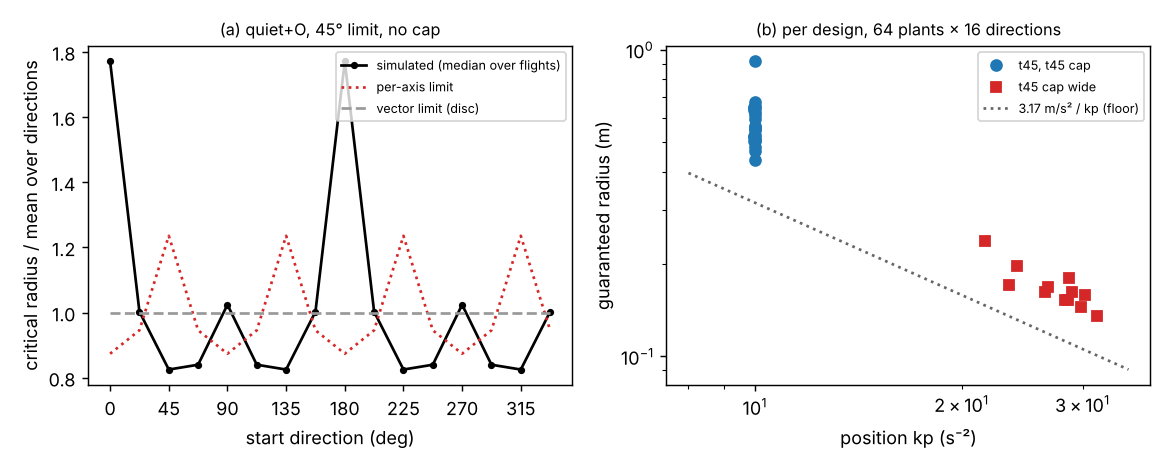
- The safe region is neither a square nor a disc. Relative to each flight's mean, the radius is 1.77 along ±x, 1.02 along ±y and 0.83 on the diagonals. It is mirror-symmetric, but turning it by 90° does not give the same shape, as it would for a symmetric airframe. Both of our candidate shapes were wrong.
- The canted rotors' side force is the cause. With the side force switched off in the simulator, the x and y radii agree within 5% for all 1,065 flights we could compare. With it on, none of 994 do. This is the same one-axis effect an earlier milestone found in position hold, where the side force hurt one horizontal axis 1.9 to 3.4 times more than the other. Here it shows up in how far the drone can start.
- The guaranteed radius. Over 64 plants and 16 directions, each design survives every start within 0.44 to 0.92 m at kp ≈ 10, and within 0.14 to 0.24 m at kp 22 to 31. For 33 of 36 designs the worst direction is at 67.5°, which is neither an axis nor a diagonal. Expressed as a request, kp · r never fell below 4.00 m/s². That is a little under the 4.3 m/s² that random directions gave.
- The cap holds, within a range. With the 3.5 m/s² cap, 9 of 55,296 flights die from a 3 m start. All nine are on one design (kp 30) and three of its plants. Up to 1 m, the cap still saves every flight.
What a builder takes from it
For a tune at a 45° tilt limit, keep the takeoff or waypoint step under about 4.0 m/s² divided by the position gain, in every direction: 0.40 m at kp 10, 0.13 m at kp 30. Alternatively, clip the proportional term's request at 3.5 m/s². On a canted airframe the strong axis flatters a stress test. Test the weak axis and the directions between it and the diagonal.
Limits
This is one simulator, with one geometry pair, lever 0, and one held-out seed of 64 plants. The 16 directions resolve the worst one to 22.5°, so a narrow worse direction between grid angles is not ruled out. "Guaranteed" means over the plants and directions we searched. The 45° limit, the 60° crash angle and the 3.5 m/s² cap are inherited settings. The numbers are in stats.txt; the predictions and outcome are in the programme's log.