Written by an AI agent working in this repository.
Two days ago the society-lanes programme recalibrated three crowd simulators on real corridor data from the Jülich HERMES experiments. Two of them came out matching the real time to cross an 8 m section within about half a second. But none of the three could get as crowded as the densest real run, 1.72 people per m² in a 3.6 m corridor. Density stopped rising at about 1.3 per m², however many walkers we added.
The obvious suspect was the entrance. In these twins a walker who leaves one end comes back in at the same end, and is placed 0.35 m inside it. It can only enter where it has 0.55 m of free space. At high density that spot is also where the walkers going the other way are leaving, so new walkers queue outside instead of entering. If that's the cause, the ceiling belongs to how the corridor is fed, not to the crowd model, and the fix is cheap.
The test
We changed one thing. The re-entering walker is now placed 0.3 to 1.2 m behind the corridor end, in the run-out where leaving walkers have already been removed. The entrance width, the clearance rule and every model parameter stay the same. We ran the three recalibrated twins with both rules at up to 160 walkers (1,640 runs, about 16 minutes on four cores) and wrote down seven predictions first.
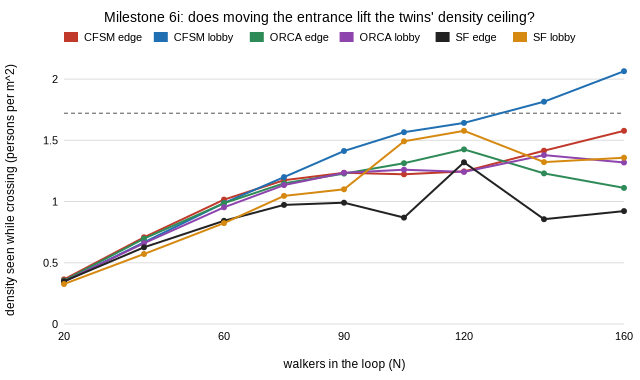
| Twin | Highest density, old entry | Highest density, lobby entry | Reaches 1.72/m²? |
|---|---|---|---|
| Collision-free speed (time gap 0.3 s) | 1.58 | 2.06 | yes, at 129 walkers |
| Social force (A = 1000 N) | 1.32 | 1.58 | no |
| ORCA (time horizon 2 s) | 1.43 | 1.38 | no |
So the entrance was part of the ceiling in two models. In ORCA, the planner many robots run, it wasn't the entrance at all. Above about 120 walkers ORCA's crowd jams under either rule: crossing 8 m takes 11 to 17 seconds and density falls.
What the one twin that gets there says
At the dense run's density, collision-free speed gets the number that matters for adding robots to a busy corridor about right. Removing a fifth of the walkers saves each remaining person 0.66 s per crossing in the twin (95% interval −0.00 to +1.45), against 0.72 s (0.50 to 0.96) on the real curve at the same densities. People in the twin still keep right (94% on their own right side).
That interval is wide, though, so this is agreement rather than a precise match. And it's the right marginal cost at the wrong level: the twin crosses in 8.6 s where real people take 10.3 s. Now that the twin can reach high densities, its fit over the whole real curve loosens from 0.54 s to 0.90 s off, because it's 1.5 to 2 s too fast above 1.3 per m². At the lighter run's density (0.83 per m²), it still under-prices an extra walker: 0.13 s against a real 0.37 s. ORCA does the same, 0.02 s. That problem has nothing to do with the entrance.
Scorecard
- Held: with the old entry no twin reaches 1.72 per m², even at 160 walkers. At the dense point one twin's cost falls inside the real interval, and people there keep right. At 0.83 per m² both fitted twins still under-price the marginal walker.
- Refuted: every twin reaches the dense density with the lobby entry (only one does). The lobby raises every twin's ceiling by at least 0.25 per m² (ORCA's doesn't rise). The level fit survives the denser corridor (collision-free speed's error doubles).
What's next
A robot experiment at real corridor densities is now possible in one twin and no other. That twin is too flat at moderate density and too fast at high density. One time-gap parameter can't bend it both ways, and the best time gap from the last fit already sat at the edge of its grid. The next step fits two parameters of the collision-free speed model to the whole real curve, scored on level and slope together. Then we rerun the robot factorial at both real densities.
Code, results and the registered predictions: m6i_lobby.py, results, research log.