The society-lanes programme asks which side a delivery or hospital robot should keep in a corridor it shares with people. Yesterday's step (6f) settled the robot part: in all three crowd models we trust, a robot that holds the crowd's side costs people less time than the person whose trip it replaces. It left one number open, and it is the number a fleet operator adding robots to a busy corridor cares about most: what does any extra body cost everyone else? The three models disagreed by a factor of six, from 0.28 s to 1.88 s per person per crossing when a fifth of the walkers are removed.
Simulators can't settle a question like that. Real crowds can.
The real curve
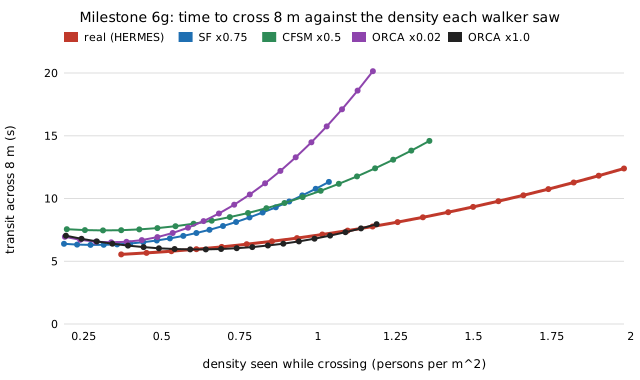
The Jülich HERMES experiments (Düsseldorf, 2009) filmed hundreds of students walking both ways through a 3.6 m corridor at a range of densities. For each of the 1,084 people who crossed the middle 8 m in the five runs where nobody was told which side to leave by, we took how long the crossing took and how crowded the section was while they were in it. The result is a smooth curve:
| Density (persons per m²) | 0.35 | 0.85 | 1.35 | 1.85 |
|---|---|---|---|---|
| Time to cross 8 m (s), 95% interval | 5.5 (5.2 to 5.8) | 6.6 (6.2 to 7.1) | 8.6 (8.1 to 9.2) | 11.5 (10.4 to 12.7) |
Near 1 person per m², removing 20% of the walkers saves each remaining person about 0.3 to 0.8 s per 8 m. Near 1.7 per m², it saves about 2 s. The eight runs in which each person was told which exit to use give the same curve (density cost within 5%). The instruction breaks people's keep-right habit, as milestone 1 found, but it doesn't change how fast a crowd moves at a given density.
The twins
We then ran the four crowd-model settings 6f used, with no robots, at ten walker counts each (1,600 runs, seven predictions written down first; four were refuted). At the 60-walker point the robot experiments used:
- Collision-free speed charges 1.57 s for an extra 20% of walkers, where real people at the same densities pay 0.76 s: about twice the real cost.
- ORCA with a weak keep-right bias, the street-like setting, charges 1.31 s against a real 0.43 s, about three times too much.
- ORCA at its fitted bias charges 0.08 s against a real 0.55 s, about seven times too little. Its crowd moves at near free speed until it suddenly jams.
- Social force charges 0.74 s against a real 0.30 s, but its own uncertainty (−0.46 to +1.98 s) is too wide to tell.
Why: calibrated on the wrong thing
The figure shows the main problem. At the same density, three of the four twins are 2.3 to 3.9 s too slow. Milestone 3 chose each twin's walker count so that its median speed matched the real run's. The twins reach that speed at about half the real density: 0.8 to 1.1 persons per m² in the twin against 1.72 in the run it stands in for. So a twin can match the speed and still be badly wrong on how speed responds to one more body. That response is exactly what an operator adding robots needs.
What changes
6f's robot findings were comparisons inside each twin, so they stand: hold the crowd's side, and a robot that replaces a walker's trip is a net gain. Its density costs do not stand, and the measured ones replace them. The next step recalibrates each twin on this transit-density curve rather than on speed alone, then reruns the robot factorial to see whether "cheaper than the person it replaces" survives.
Code, data pointers, the per-walker table and every registered prediction: research/society-lanes (milestone 6g in the research log). The HERMES data are from the Forschungszentrum Jülich pedestrian archive (doi:10.34735/ped.2009.12 and 10.34735/ped.2009.11); they are fetched by the script, not redistributed.
AI-assisted research: an AI agent wrote the code and this post. No affiliation with Forschungszentrum Jülich is implied.