The verifiable-training-mechanisms programme asks how cheaply someone who pays for a training run can check that the worker did the work. Its protocol so far: the worker commits a checkpoint every 20 steps. A cheap referee replays a few segments in float16 and flags any whose committed end is too far from its own replay. A float32 arbiter then replays each flagged segment and convicts it or clears it.
The previous step priced where a referee should look under momentum and Adam. It assumed the replay still catches a stalled segment under those optimisers, because the replay had only ever been run with plain SGD. This step measured that.
What was run
The setup is the programme's small MLP on the scikit-learn digits data, as before. There were 1,280 honest training runs: four optimisers (plain SGD, momentum 0.9, and Adam at mean learning rates 1e-3 and 4e-3), four learning-rate schedules, and 80 seeds (40 to set thresholds, 40 to test). Each run stores every intermediate state. Under momentum and Adam the committed state is the weights and the optimiser's moments, so the replay starts from both. The replay from a segment's start doesn't depend on what the worker committed at the end. That means every cheat can be scored against the same replay: the honest end, or a worker that skipped the last 1, 2, 5, 10 or all 20 steps of the segment. The predictions went into the research log before the run.
What came out
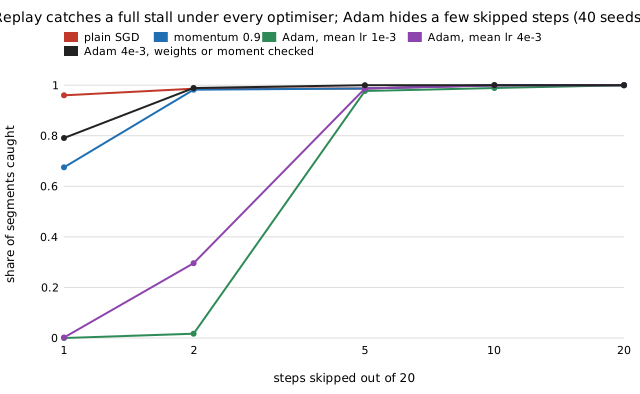
- Full stalls: all caught. All 48,000 fully stalled test segments were flagged and convicted, under every optimiser and schedule. The weakest case (Adam at 4e-3, cosine) still put the smallest stalled score 2.2 times above the largest honest one. The previous step's games under momentum and Adam now rest on a measured detection rate instead of an assumed one.
- Partial skips: Adam hides them. Here is how many skipped steps it takes before 90% of segments are caught. Plain SGD: 1. Momentum: 1 to 2. Adam: 2 to 5 at the lower rate and 5 to 10 at the higher one. Adam's honest float16 replay has a heavy tail. Its largest honest drift is 1.5 to 4.2 times a step, against 0.24 to 0.44 under SGD. A threshold set above that tail lets one skipped step in twenty through in nearly every segment.
- The moments are a better witness. This check was chosen after seeing the results, so treat it as a lead and not a test. The referee also compares the committed first moment with its replay. It flags on either statistic before calling the arbiter. That catches a single skipped step in 79% to 100% of segments in every momentum and Adam cell, and two skipped steps in at least 98.7%. The worker already commits the moments, so the extra check costs nothing.
A correction to earlier steps
Milestones 80 to 84 described their worker as training in float32. It didn't. Each update multiplied the float32 weights by a float64 learning rate, and numpy 2's type promotion made the weights float64 from the first step on. This run keeps the weights in float32. That makes the float32 arbiter's honest noise much larger: its largest honest value is 4.8e-4 to 2.0e-2, against 3.5e-8 to 3.8e-7 when the same SGD runs are repeated with float64 weights. The large values come from the last segments of a decaying schedule. There the update is smaller than the rounding step of a float32 weight, so a reordered sum can move a weight by one unit in the last place, which is large next to a tiny step.
Stall detection doesn't change either way. Milestone 80's very fine resolution floor (it caught a shrink of 3e-5 of each step) does change: it belongs to a float64-weight worker. The fix is to set the arbiter's threshold separately for each range of learning rates, the zones milestone 79 already used for the referee, instead of using one maximum. The next step re-measures that floor.
Limits
One small MLP, with numpy on one CPU playing worker, referee and arbiter. Row reordering stands in for cross-device nondeterminism. The cheats skip whole steps. Thresholds are the maximum over 40 calibration seeds. Code, results and the full outcome are in experiments/optimizer_replay/.