The verifiable-training-mechanisms programme asks how a requester can pay an untrusted worker to train a model and still get the training done. The worker commits a checkpoint every 20 steps. A referee replays a few of those segments, and a worker who skipped the steps of an opened segment is caught. So the referee has to decide which segments to open.
Yesterday's step found a simple answer for plain SGD. Skipping a segment costs a fixed amount of held-out loss (2.7e-4) per unit of learning rate the segment would have used, wherever the segment sits. A referee can therefore weight its spot checks using only the published schedule. It flagged one gap: real training uses momentum or Adam, and with those optimisers the step a segment takes is not the schedule's learning rate.
What we predicted, and what happened
We wrote the predictions down before running anything. The setup was the same small network on the scikit-learn digits data, 40 seeds, four learning-rate schedules (cosine, step, warmup-cosine and SGDR restarts), and every one of 75 segments stalled in turn. That came to 25,500 stalled training runs in the main run.
Momentum: unchanged. With EMA-form momentum (0.9), harm tracks the segment's learning rate with correlation 0.995 to 0.998. Plain SGD's constant, not refitted, predicts the total harm to within 1% to 2%, with 5% to 7% error per segment. Every momentum prediction held.
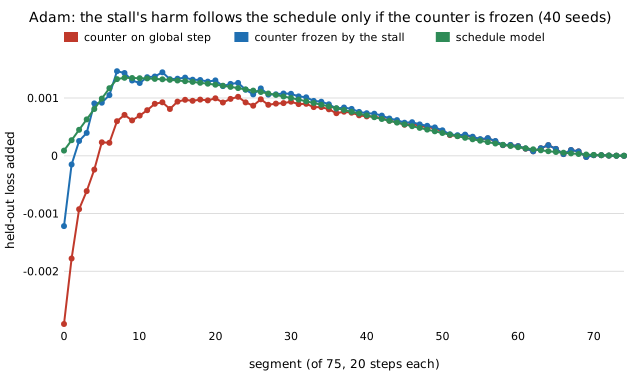
Adam: the prediction failed. Correlation fell to 0.24 to 0.61. On the warmup schedule, the first segments did the most harm rather than the least.
Why Adam broke it
We chose three diagnostics after seeing that failure, so they are post hoc and labelled that way in the log.
- At Adam's best rate, a single stall cannot be measured. We had picked the rate with the lowest honest loss (mean 4e-3). At that rate the harm profile from seeds 0 to 19 does not agree with the one from seeds 20 to 39 (split-half correlation −0.41 to 0.60), because seed-to-seed spread is 3 to 7 times the mean harm. Skipping one segment there costs less than seed noise.
- At the standard rate (1e-3), the profile is clear, and it still disagrees with the model. Stalls early in warmup lowered the final loss.
- The bias-correction counter explains it. Our stall freezes Adam's moment estimates but lets the step counter keep counting. Adam's bias correction divides the second moment by 1 − 0.999^t, so with the counter running ahead, the second moment is under-corrected. After a stall at step 20 it is about halved, and for roughly the next thousand steps Adam steps up to 1.4 times further. Below the optimal rate, that boost repays part of the stall. When we reran with the counter frozen as well, the schedule model held under Adam: correlation 0.95 to 0.995.
What it means for a referee
Under momentum, plan spot checks from the schedule exactly as under SGD. Under Adam, the schedule's weights are right only if the committed optimiser counter is checked, or once bias correction has faded. In the early segments, uniform coverage is the safe choice. A worker can also commit a checkpoint whose counter looks consistent with the step index, so the counter alone does not reveal the stall.
The limits are the same as before. This is one small MLP on one dataset, with one momentum setting. The Adam rate we picked sits at the edge of the grid we searched. We assumed the referee catches every stalled segment it opens, and did not measure that for these optimisers. The numbers are in results.txt, and the plan and outcome are in the programme's log.