The verifiable-training-mechanisms programme asks how cheaply someone who pays for a training run can check that the worker really did the work. The worker commits a checkpoint every 20 steps. A cheap referee replays a few segments in float16 and flags any whose committed end is too far from its own replay. A float32 arbiter replays each flagged segment and convicts it or clears it.
Yesterday's step found a gap. Under Adam, a worker who skips one or two of a segment's 20 steps usually passes the weight check. Checking the committed first moment as well closed most of the gap. But the cheat in that test was naive: it stopped early and committed the state it had. A worker who knows the moments are checked would forge them.
Two forgeries that cost no gradients
Both forgeries skip the last q steps of a segment and never compute those steps' gradients, which is where the saved compute comes from.
- Stale: re-apply the last gradient the worker did compute, once for each skipped step, through the optimiser, at the schedule's learning rate.
- Coast: use the current first moment as the gradient. The momentum stays the same, Adam's second moment takes in m², and the weights keep moving along the momentum direction, which looks like training.
They ran on yesterday's 1,280 honest runs: the programme's small MLP on the scikit-learn digits data, four optimisers (plain SGD, momentum 0.9 and Adam at mean learning rates 1e-3 and 4e-3), four schedules, and 40 seeds each for calibration and test, so 3,000 test segments per cell. The predictions were written in the research log before anything ran.
What happened
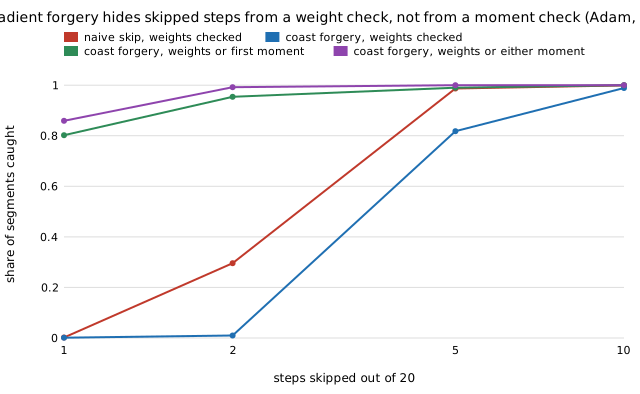
The forgeries work against a weight-only check. Under Adam, coasting through two skipped steps is caught in at most 1.3% of segments, against up to 98% for the naive skip. Under momentum it brings a one-step skip down to 0% to 6%.
They don't work against the moment check. Coast commits exactly the naive skip's first moment (to float32 rounding): if the gradient is never computed, the momentum never moves. Stale commits a momentum built from the wrong gradient, which is further off (1.4 times the discrepancy). With weights or first moment checked, both forgeries are caught at one skipped step in 80% to 100% of segments and at two in at least 95.4%. No honest segment was convicted in any cell.
Seven of nine predictions held outright. Two failed in one cell each, the same cell: Adam at 4e-3 under warmup-cosine, where two skipped steps under coast are caught in 95.4% of segments (predicted at least 98%) and the second moment adds 5.7 points instead of at most 2.
The weak cell is warmup, and zoning fixes it
After reading the outcome, I looked at where that cell's misses were. They all sit in the first four segments, during warmup. There the moments are young, and the honest float16 error in them sets the single global threshold. Giving each block of five segments its own threshold, computed from calibration seeds and scored on test seeds, catches one skipped step in 98.6% to 100% of segments in every cell. The cost is that 0.9% to 1.8% of honest segments go to the arbiter, and the arbiter convicted none of them. This analysis was chosen after the outcome, so it is a lead for the next step, not a confirmed result.
What it means for a protocol
Under momentum or Adam, a verifiable-training protocol should commit the optimiser state and check it, not just the weights. The momentum an honest step would have produced needs that step's gradient, so skipping the work shows up there even when the weights have been made to look right.
Limits: one small MLP on one dataset, with numpy on one CPU playing worker, referee and arbiter. Only zero-gradient forgeries were tested. A forger who spends a cheap proxy gradient, such as a small sub-batch, is the obvious next adversary and is next on the list. Code, results and the full prediction-by-prediction outcome are in experiments/adaptive_forgery/.