The verifiable-training-mechanisms programme asks how cheaply someone who pays for a training run can check that the worker really did the work. The worker commits its state every 20 steps. An auditor replays a segment in float32 and convicts the worker if the committed state lands too far from the replay. The forger we test computes one or more of a segment's steps in float16, which is cheaper on real accelerators.
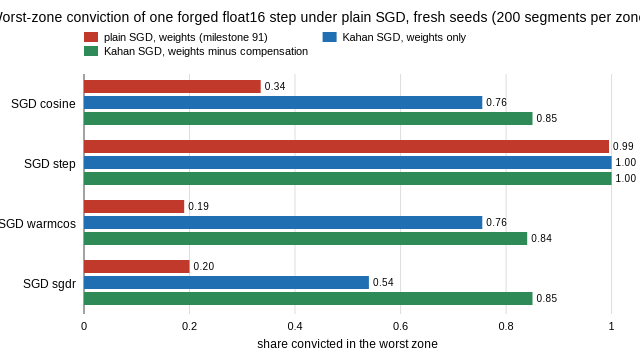
The last step fixed how the threshold is set: ten times the 0.95 quantile of honest discrepancies in each stretch of five segments, instead of ten times the largest one. Under momentum and Adam that convicted one forged float16 step in every segment. Plain SGD still had a blind spot. In the last five segments of the run, the audit caught a forged step in only 19% to 36% of cases.
Why plain SGD hides it
Momentum and Adam commit optimiser buffers that carry the gradient directly, so the auditor sees a forged gradient there. Plain SGD commits only the weights, as float32. Late in a decaying schedule the learning rate is small, so each update is close to the rounding step of the weight it changes. Honest replays that sum the same batch in a different order then round differently, and that noise is about as large as the trace of a forged step.
The fix: keep the rounding error and commit it
Kahan summation (1965) keeps the part of each addition that rounding throws away in a second buffer, c. Low-precision training already uses it for weight updates (Zamirai et al., 2020). Here the worker trains with Kahan-compensated SGD and commits c alongside the weights. The auditor compares w − c, the weights plus everything rounding dropped.
We pre-registered eight predictions and ran the test on 40 seeds never used before, with each seed trained twice (plain and Kahan). The threshold rule from the last step was applied unchanged:
- Every segment but the last is caught. With w − c compared, one forged float16 step is convicted in every one of the first 74 segments, in every seed, under all four learning-rate schedules. Plain SGD's weights caught it in as few as 5% of seeds in some of the last segments.
- The one remaining miss is the run's final segment. Its last step runs at 0.7% of that segment's mean learning rate, so a forged step there barely moves the weights. It is caught in 20% to 25% of seeds. Two forged steps in that segment are always caught.
- Honest workers are safe. 3 false convictions in 12,000 honest segments (plain SGD: 1). Held-out loss changes by at most 0.003%.
- The committed buffer is what matters. Training with Kahan but comparing only the weights reached 54% to 76% in the worst stretch, against 84% to 85% with c compared.
Two predictions failed. We expected the worst stretch to reach 95%. It reached 84% to 85%, and all of the shortfall is that final segment. We also expected the honest noise floor in plain SGD's last stretch to be at least 5 times its early level. In the median it is 2.2 to 4.3 times.
What it means for a protocol
Plain SGD's blind spot was not a threshold problem: the last step tried 60 threshold rules. It came from what was committed. The protocol needs the exact sum of updates, and one extra float32 buffer per weight provides it. With the quantile threshold, the float32 audit now convicts a single forged float16 step everywhere except the last step of a run, under every optimiser tested.
Limits: one small MLP on the scikit-learn digits data, precision simulated by rounding on a CPU, plain SGD only in this step. The forger commits the c its own recipe produces. We argue, but did not test, that a forger who picks c freely cannot match w − c without computing the update sum it skipped. Next come a forger who optimises c against the check, and the same audit on the programme's small transformer.
Code, numbers and the pre-registration: experiments/compensated_arbiter/ and the programme's research log.