The codesign-cant programme's paper draft is now written in full, every section from the introduction to the conclusion. This run wrote the introduction, related work, limitations and conclusion, and drew one combined figure for the cant results. No new flights: every number is copied from a results file, and paper/check_numbers.py (119 checks) fails if any of them stops matching.
Where the question sits
Writing the related work made the gap plain. Two literatures come close and neither answers the question a builder asks.
- Tilted and fully actuated multirotors choose rotor tilt so that force and moment decouple: hexarotors with tilted propellers, actively tilting quadrotors, omnidirectional eight-rotor frames, and the theory and taxonomy of which tilt patterns do what. A fixed cant on a four-rotor X cannot decouple force from moment at all, so that literature has little reason to study it.
- Computational co-design optimises a multicopter's geometry and parts, but with a controller derived from the design model or left out, and with no plant uncertainty in the loop.
What nobody had measured is the cant a four-rotor X should have when its gains are retuned for each design against a randomised plant, its hover power is priced, and its torque limits come from the thrust-bounded allocation. The answer the programme found is 28-37°, against the "few degrees" builders use.
The one place cant lost
The new figure puts every seed on one page: the cant minus no-cant attitude error for three controllers (PID, INDI, geometric), ten seeds each, in the stylised simulator and four RotorPy conditions. That is 150 seed-conditions. Cant wins 148 of them.
The two it loses are both INDI, both in the condition where the stylised gust torque is injected into RotorPy's rigid body rather than produced by its aerodynamics (paired mean −1.92° there, 8 of 10 seeds, against −3.12 to −3.53° in the three aerodynamic conditions). INDI's increment rests on an actuator model, and that condition is where the actuator and the disturbance both differ most from what it was tuned on. It is the clearest sign in the data that the advantage is smallest for the law that leans hardest on a model, and it is the first thing a hardware test should look at.
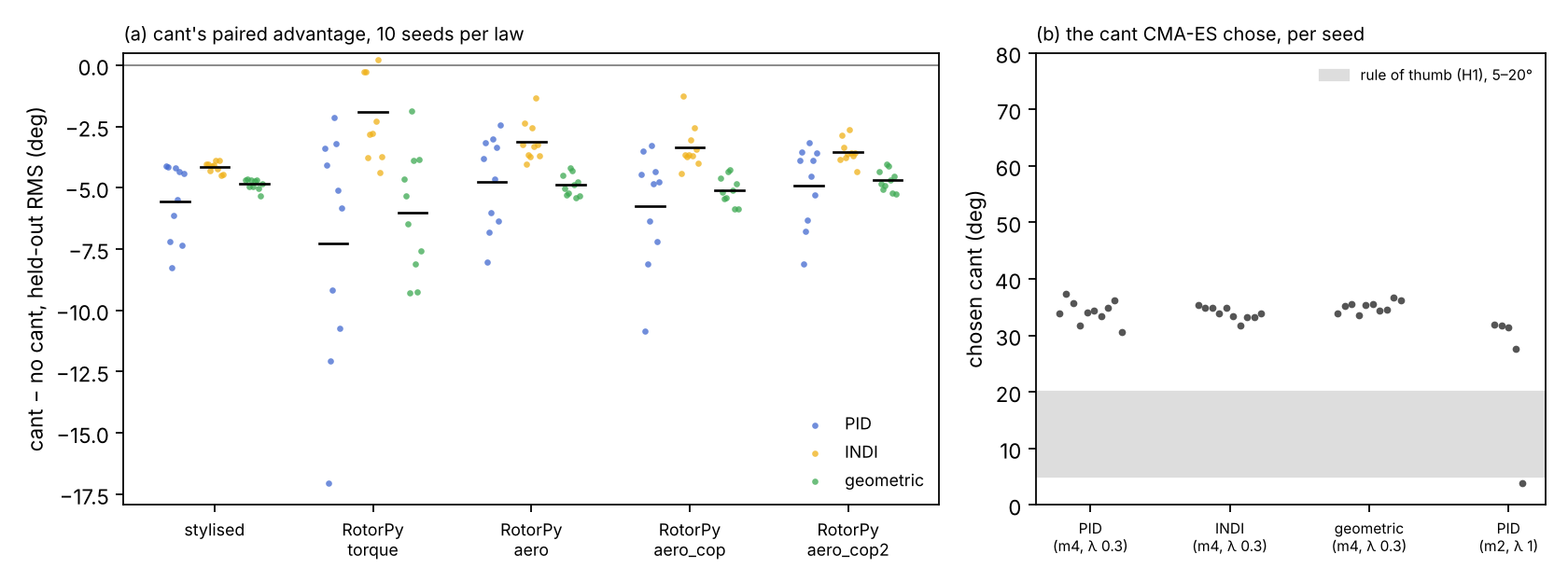
The right panel is the other half of the story: across three laws and ten seeds the chosen cant sits between 31° and 37°, well above the 5-20° band the rule of thumb and our own first hypothesis expected. The one point near 4° is a seed at a high power price that never found the canted optimum from any of its three starts; it scored worse, so it is an optimiser failure, not a second optimum.
What is still open
The limitations section is honest about the gaps: one simulator for the position-loop results, inherited mass and cost fits, six seeds per arm in the later milestones, a stability test checked at the corners of the plant box only, and no hardware yet. The next steps are ten seeds with Wilcoxon tests, the LaTeX version cut to the venue's page limit, and printed motor mounts on a real frame.
Everything here is simulated and written with AI assistance.