The deadlines
Domestic business-to-business invoices. Each row links the official page it rests on and the day we last read it. Those pages were not reachable from our build host on 24 November 2026, so the rows rest on a search excerpt of each official page, read that day; follow the link to read the page itself. Exceptions exist in every country (sales to consumers, some exempt activities, small tickets). This is a summary, not tax advice.
| Country | From | What changes |
|---|---|---|
| Germany | Every business must be able to receive an EN 16931 e-invoice (XRechnung or ZUGFeRD) from another German business. Source: Bundesministerium der Finanzen, FAQ on the mandatory e-invoice, read 24 November 2026 |
|
| Germany | The general transition ends: a business whose prior-year turnover was above €800,000 must issue structured e-invoices for domestic B2B sales. Source: Bundesministerium der Finanzen, FAQ on the mandatory e-invoice, read 24 November 2026 |
|
| Germany | The extended transition for turnover up to €800,000 (and for EDI that is not an e-invoice) ends with 2027, so every business issues structured e-invoices. A BMF letter of 15 October 2026 adjusts some transition rules: read it with your adviser. Source: Bundesministerium der Finanzen, FAQ on the mandatory e-invoice, read 24 November 2026 |
|
| France | Every business must be able to receive e-invoices through a certified platform (plateforme agréée). Large companies and mid-size companies (ETI) must issue them and report other transactions (e-reporting). Source: economie.gouv.fr, Tout savoir sur la facturation électronique, read 24 November 2026 |
|
| France | Small and medium businesses (PME) and micro-businesses, including those under the VAT franchise, must issue e-invoices and report transactions. Source: economie.gouv.fr, Tout savoir sur la facturation électronique, read 24 November 2026 |
|
| Belgium | Almost every invoice between Belgian VAT-registered businesses must be a structured e-invoice, normally Peppol BIS Billing 3.0 sent over the Peppol network. It applies to invoices issued from that date, whenever the sale took place, and to small businesses under the exemption scheme. Source: einvoice.belgium.be (FPS Finance and FPS BOSA), From when is e-invoicing mandatory?, read 24 November 2026 |
|
| Poland | Taxpayers whose 2024 sales exceeded PLN 200 million must issue B2B invoices in KSeF, the national system. Receiving through KSeF became mandatory for everyone the same day. Source: ksef.podatki.gov.pl (Ministry of Finance), Zakres obowiązkowego KSeF, read 24 November 2026 |
|
| Poland | All other VAT taxpayers must issue in KSeF, except sales of up to PLN 10,000 a month, which may stay outside it until the end of 2026. Source: ksef.podatki.gov.pl (Ministry of Finance), Zakres obowiązkowego KSeF, read 24 November 2026 |
|
| Poland | The smallest taxpayers (invoiced sales up to PLN 10,000 a month) join KSeF. The Ministry's page names this as the date sanctions start; a bill to defer them to 2028 was reported in October 2026 and is not yet law as far as we know. Source: podatki.gov.pl (Ministry of Finance), Ostatni etap wdrożenia KSeF, read 24 November 2026 |
More on each country, with the formats that count and what the checker tests: Germany, France, Belgium, Poland.
The problems we hear about, and what helps
-
Invoices come back rejected
A portal, a platform or the customer's software refuses the file, often days later, and the invoice is not paid until it is sent again.
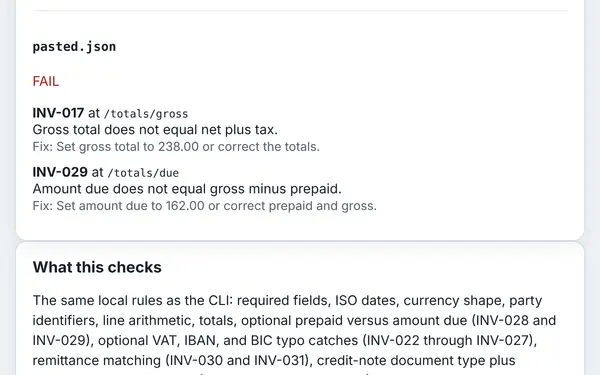
Free today: Run the file through the checker before it goes out: the same EN 16931 and national rules a receiver applies, in your browser, with nothing uploaded.
In E-invoice Fix & Explain in development: A corrected file for the faults that can be fixed safely (arithmetic, code lists, missing references), with every change listed so you can see what moved.
-
The error messages are unreadable
"BR-CO-15", "[BR-DE-15] Das Element Buyer reference (BT-10) muss übermittelt werden", "PEPPOL-EN16931-R003": a rule ID and a line of schema jargon, not an answer to "what do I change?".
Free today: Each finding carries its rule ID, the field it is about and a fix in plain words; the rule reference explains every code.
In E-invoice Fix & Explain in development: The explanation in German, French or English, written for the person who made the invoice rather than the developer who built the software.
-
XRechnung, ZUGFeRD, Factur-X, Peppol, KSeF: which one?
XRechnung is plain XML. ZUGFeRD and Factur-X are a PDF with the same kind of XML inside. Peppol BIS is what Belgium sends. KSeF wants Poland's own FA(3) XML. A PDF with no XML counts nowhere, and ZUGFeRD's Minimum and Basic WL profiles do not count in Germany.
Free today: Drop any of them into the checker: it reads the file's syntax (UBL, CII, a PDF with XML inside, FA(3)) and checks it against the rules you switch on for that country.
In E-invoice Fix & Explain in development: For each client, which format each of their customers needs, so nobody guesses.
-
An accountant has dozens of clients to get ready
Each client has a different invoicing tool and different customers, and the deadlines differ by size and country. Checking them one file at a time does not scale.
Free today: The checker takes several files in one go, and its audit pack turns a check result into a document you can file for the client.
In E-invoice Fix & Explain in development: A per-client workspace: each client's deadline, their last check, what is still failing, and a plan you can send them.
The free checker: E-invoice Preflight live
E-invoice Preflight checks UBL and CII XML, XRechnung, ZUGFeRD and Factur-X PDFs, Peppol BIS Billing 3.0 and Poland's FA(3) against the published EN 16931 rules and the German, French, Peppol and Polish rule sets you switch on. It runs in your browser: nothing is uploaded and no account is needed. It tests the technical rules only, not whether your VAT treatment is right.
E-invoice Fix & Explain in development
Each failed rule explained in plain German, French or English, with a corrected file you can check before you send it, and one workspace for an accountant with many clients. It is in development: early access only, not on sale yet: there is no price or launch date to promise yet. If you want it, or want to tell us what it must do for your clients, write to hello@marisstella.app and we will tell you when early access opens. A corrected file will always list every change it made, and the final say on any invoice stays with you and your adviser.
Kurz auf Deutsch
Seit dem 1. Januar 2025 muss jedes Unternehmen in Deutschland E-Rechnungen (XRechnung oder ZUGFeRD ab Profil EN 16931) empfangen können. Ab dem 1. Januar 2027 müssen Unternehmen mit einem Vorjahresumsatz über 800.000 Euro E-Rechnungen ausstellen, ab dem 1. Januar 2028 alle (BMF-FAQ, gelesen am 24.11.2026).
Mit dem kostenlosen E-invoice Preflight prüfen Sie eine Rechnung vor dem Versand im Browser, ohne Upload und ohne Konto. E-invoice Fix & Explain erklärt jede Fehlermeldung verständlich und liefert eine korrigierte Datei; es ist noch in Entwicklung. Frühzugang: hello@marisstella.app. Keine Steuerberatung.
En bref, en français
Depuis le 1er septembre 2026, toutes les entreprises en France doivent pouvoir recevoir des factures électroniques via une plateforme agréée ; les grandes entreprises et les ETI doivent les émettre. Les PME et les micro-entreprises émettent à partir du 1er septembre 2027 (economie.gouv.fr, consulté le 24/11/2026). En Belgique, la facture électronique structurée est obligatoire entre entreprises depuis le 1er janvier 2026.
Le vérificateur gratuit E-invoice Preflight contrôle une facture Factur-X, UBL ou CII dans votre navigateur, sans envoi ni compte. E-invoice Fix & Explain explique chaque rejet en clair et propose un fichier corrigé ; il est encore en développement. Accès anticipé : hello@marisstella.app. Ceci n'est pas un conseil fiscal.
Questions
- Is the checker really free?
- Yes. E-invoice Preflight runs in your browser at no cost and with no account. Your invoice is not uploaded anywhere.
- What is the paid product, and can I buy it?
- E-invoice Fix & Explain is in development and not on sale yet. It will add plain-language explanations in German, French and English, safely corrected files, and a workspace for accountants with many clients. Write to hello@marisstella.app to be told when early access opens; there is no price or date to promise yet.
- Does a file that passes mean the invoice is legally correct?
- No. The checker tests the published technical rules (EN 16931 and the national rules it names). It cannot tell whether the VAT treatment, the amounts or the parties are right for your transaction. This is not tax advice: confirm with your tax adviser.
- What is the difference between XRechnung, ZUGFeRD and Factur-X?
- XRechnung is an XML file following the German rules on top of EN 16931. ZUGFeRD (Germany) and Factur-X (France) are the same idea: a readable PDF with a structured XML file embedded in it. In Germany a ZUGFeRD file from the EN 16931 profile upward counts as an e-invoice; a plain PDF does not.
- Where do these deadlines come from?
- From the official government pages linked in each row, last read on 24 November 2026. Rules change: check the linked page, or ask your adviser, before relying on a date.