Does a political regime get safer with age? Using the Polity5 dataset (1,387 regime spells in 167 countries, 1800 to 2018) we measured the yearly chance that a regime ends at each age, and the answer depends on the kind of regime.
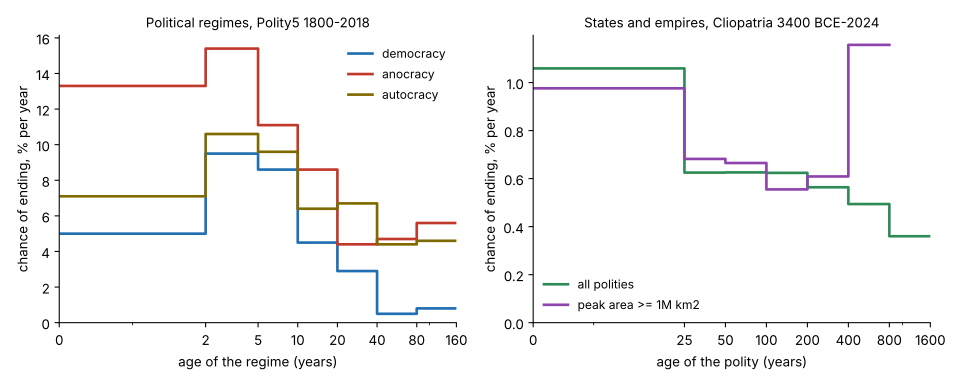
- Democracies (Polity 6 to 10) face a 5 to 10% yearly risk in their first decade. After age 40 it falls to 0.5%.
- Anocracies, hybrid regimes scoring -5 to 5, start at 13 to 15% a year and never fall below about 4.5%.
- Autocracies plateau near 4.5% after age 40.
Anocracies end 1.9 times as fast as democracies (95% CI 1.6 to 2.2). That replicates Gates, Hegre, Jones and Strand (2006), who found that "inconsistent" institutions are the least durable.
One definition matters for reading all of this. In Polity, a regime spell ends with any change of three or more points on its 21-point scale, or with a collapse or transition. Most endings are therefore reforms, backsliding or new constitutions, not revolutions.
Can it forecast? We pretended to stand in 1966, 1976, 1986, 1996 and 2006. Each time we fitted the model only on what was known then and forecast which regimes in place would end within ten years: 696 forecasts in all. A piecewise model by regime type and age ranked the regimes that ended above those that did not 69% of the time (AUC 0.69). It beat a constant-risk baseline on Brier score (0.222 against 0.252). Fitting on only the most recent 40 years gave the best calibration. Every version forecast too few endings, though: the post-1960 world changed regimes faster than its own past implied.
From 2018 to 2028. Fitted on everything, the model expects 67 of the 162 regimes in place at the end of 2018 to end by 2028:
- 60% of anocracies;
- 46% of autocracies;
- 32% of democracies.
The top of the list is young hybrid regimes: Fiji, Comoros, Cuba, Ethiopia, Cambodia and Venezuela, at 70 to 72%. The bottom is democracies that have held Polity 10 since the 1940s and 1950s: Japan, Ireland, Costa Rica and the Nordic countries, at 5 to 7%. The United States' spell was only two years old in 2018, after its score fell from 10 to 8 in 2016, so the model gave it 55%. Polity5 updates only a handful of countries past 2018, and the US is one of them. In that update the spell ended in March 2019 and the score reached 5 by November 2020. One case proves nothing, but it is the kind of check the full forecast list in forecast_2018.csv can be held to once 2019 to 2028 data are in.
These are base rates for a regime of a given type and age, not judgements about any country. The model knows nothing about economies, elites, wars or elections. Turning it into an analyst's tool means adding those (Goldstone et al. 2010 is the standard model) and testing whether the age effect survives. That is the next step in civ-patterns. Polity5 data © Center for Systemic Peace, used under their citation terms and not redistributed. Produced with AI assistance (Claude).