The cell-fidelity programme forecasts how much lithium a battery design loses to plating over 100 cycles from its first ten, so an electrode design search can skip 90 cycles of the full DFN model. The forecast needs one kinetic exponent per cell type. Earlier milestones read the potential that slows plating at one point, the separator side of the negative electrode, where plating is usually said to be fastest. On two of PyBaMM's four parameter sets that explained the exponent. On Ai2020 it was three times too high, and on Chen2020 too low (the last milestone).
This milestone asked a plain question first: where through the electrode does the plating actually happen?
Mostly not at the separator
We re-ran the 40 designs of an earlier step (5z) to 100 cycles and integrated PyBaMM's plating current at each of the 20 nodes through the negative electrode, every cycle. The re-runs reproduce the committed records to 3 parts in 10 million.
The separator-side node does plate the most per node on every set, but it carries only 8 to 19% of the total. The plating-weighted depth is 0.53 to 0.72 of the way from the current collector to the separator. On NCA_Kim2011 the profile is nearly flat.
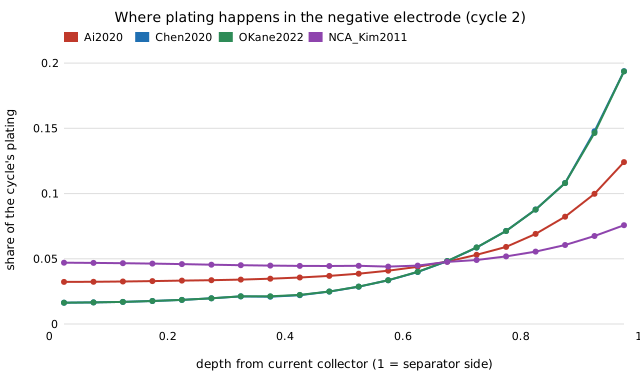
That explains an old puzzle. On NCA_Kim2011 a rate index read at the separator node had missed the cell's plating slowdown by 0.49 in log units. Here, the separator node's own plating slows by 0.28 less than the electrode's total, because the inner nodes slow faster and the plating drifts toward the separator over the 100 cycles. On the LG M50 sets the gap is 0.015.
The exponent is somewhere else
The registered test was whether the potential lever, read where the plating is rather than at the separator, gives the exponent the forecast needs. It does not. Weighted by where the plating sits, the open-circuit potential rises 0.64 times as much as at the separator on Ai2020, and 0.78 to 0.81 times on the two LG M50 sets. That moves Ai2020's implied exponent from 73 to 47 (it needs 21), and moves Chen2020 (27 against 52) and OKane2022 (28 against 38) further off. Only NCA_Kim2011 lands within 25%.
| set | lever-implied exponent | read at the plating | needed |
|---|---|---|---|
Ai2020 | 73.5 | 47.3 | 20.8 |
Chen2020 | 33.0 | 26.8 | 52.3 |
OKane2022 | 36.6 | 28.4 | 38.1 |
NCA_Kim2011 | 22.6 | 27.3 | 23.0 |
The last milestone tried a different correction, the other terms of the plating overpotential at the separator node, and got almost the same factors (0.59 and 0.80). Two independent ways of reading the measured potential better move every set in the same direction, while the sets need opposite corrections. So the set differences are not in the measured potential. They are on the other side of the ratio, in the forecast law's own lever: how it turns lost lithium into a potential rise on each set's open-circuit curve. That comparison needs no new simulation, since both sides are now recorded, and it is the next step.
Caveats
One pool per parameter set (7 to 12 designs); the needed exponents come from other pools of the same sets; OKane2022's plating parameters on every set; one PyBaMM version (26.10.1.1); a 20-node mesh; modelled fade, not measured. The plan and hypotheses (H191 to H194: three supported, one refuted) were committed before the bench ran, in the project's log; the numbers are in results.txt.