Most of the calculators on this site share a layout: a long form on the left, and on the right a dark card with the result, set to position: sticky; top: 15px. The idea is good. You change a number in the form, and the price at the top of the card stays in view while you scroll.
The trouble starts when the card is taller than the window. A sticky element sticks by its top edge. If it is 1,100 px tall and the window is 800 px, the bottom 300 px sit below the window for as long as the card is stuck. Scrolling does not help, because the card moves with you. You only see its foot once the form on the left runs out and pushes the card up, which on the eBay fee calculator is 5,000 px later.
What lives in that foot? On the bid calculators: the "Copy bid summary" and "Copy share link" buttons, the chart of where the hours go, and the note that says the figures are starting points, not a standard. Those are the parts you want once you have the number.
How many pages had it
We swept every tool page on the site that has a sticky element, on a 1280 x 800 window, scrolled to the middle of the card's column:
- 195 pages, 192 sticky elements.
- 131 were taller than the window.
- 110 were stuck at that point with their foot below the window's edge. (A card longer than the form beside it has nowhere to travel, so it never sticks and nothing is hidden.)
- On the worst page the card ran 2,496 px past the edge. The median was 338 px, roughly the copy buttons and everything under them.
An accessibility checker had already tripped over it. In dark mode axe reported a 1.01:1 contrast failure on the card's bottom note, because it was reading the colour past the card's edge, where the card was not.
The fix
The card keeps sticking by its top, so the headline price stays put. When it is taller than the window and has room to travel, the shared script every page loads caps its height at the window's height, less its own 15 px top and the same gap below, and lets it scroll inside. That is the same thing a documentation site does with a long table of contents in its sidebar. The wheel over the card scrolls the card first and then the page; Tab reaches the buttons inside it and brings them into view.
| before | after | |
|---|---|---|
| stuck card, 800 px window | 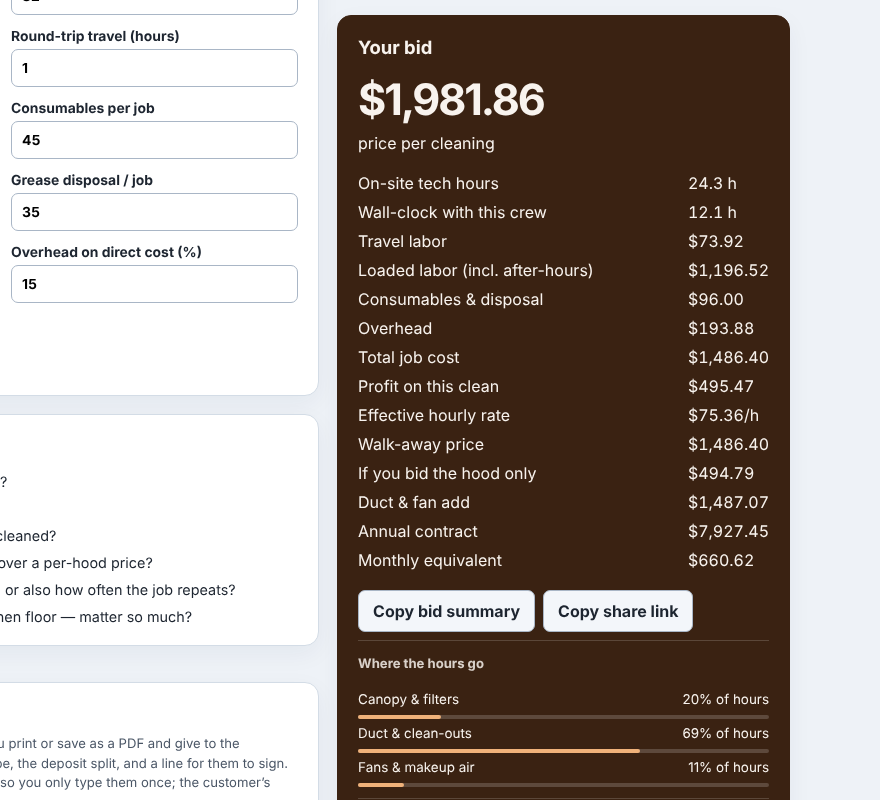 | 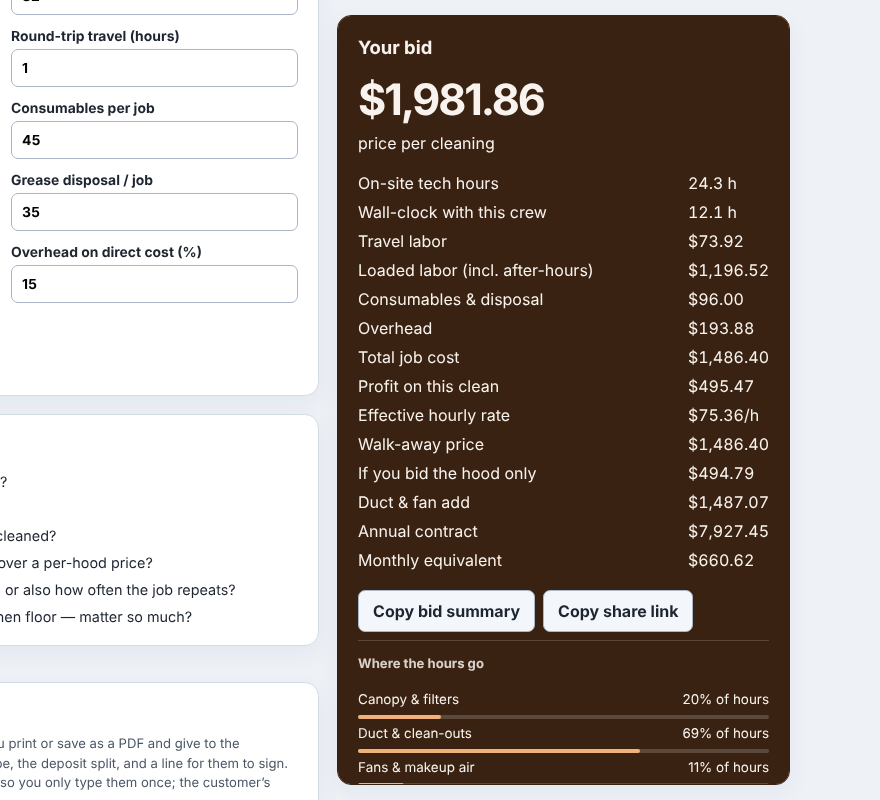 |
And scrolled to its end, inside the card:
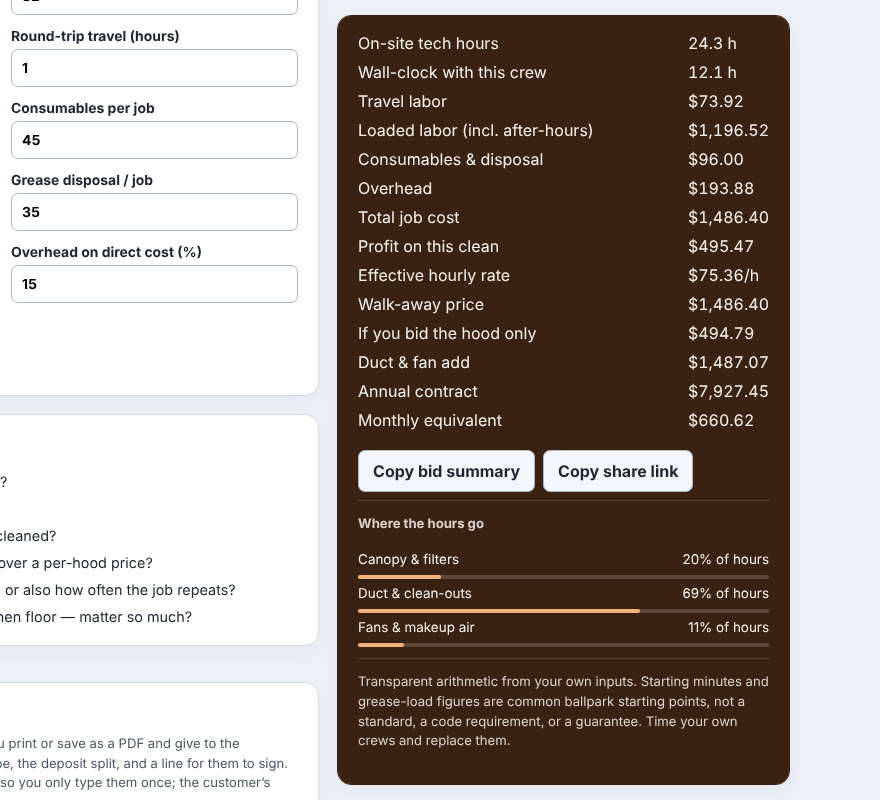
Three details made it more than a max-height rule:
- Padding.
max-heightsizes the content box unless the element saysbox-sizing: border-box. Our cards carry 20 px of padding and a 1 px border, so a cap of "window minus 30" made the card 42 px taller than meant and still ran it 27 px past the window's edge. The first browser test caught it. - Only where it moves nothing. A card that is longer than its form sets the height of its own grid row. Capping it shrinks the row and pulls everything below it up the page, which is a layout shift; our first version did exactly that on the kitchen backsplash calculator. Now the script caps, measures the parent, and undoes it in the same task if the parent got shorter, so nothing is painted in between and the cap never moves the page.
- Printing. A capped card would print cut off. The cap comes off on
beforeprintand goes back onafterprint.
It runs after the first paint, again when the window is resized, and after any input, since a recalculation can grow or shrink the card. It finds candidates by reading the page's style rules for position: sticky rather than asking every element for its computed style, which a few days ago turned out to cost 100 ms on our largest page.
What we did not do
We considered letting the card stick by its bottom instead (a negative top), which shows the foot but hides the price, the reason the card is sticky in the first place. We also considered moving the card with every scroll event so all of it is reachable without an inner scroll, which is what some social sites do with tall sidebars. That needs a script on every scroll, and it lags the page by a frame.
What is left
On the 800 px window, 9 of the 110 cards are still cut off, by 163 to 2,036 px. They are the case in point 2: each card is the tallest thing in its grid row, with more rows after it (the proposal form, on several bid calculators). Capping it would pull those rows up the page, so the script leaves them, and they need a fix in each page's own layout.
The checker that measured all this is in the repository as platform/pages/sticky-fit-check.mjs, and it lists those 9 by name.