The society-lanes programme asks which side a mobile robot should keep in a corridor that people also walk. The last step found something useful. Three crowd simulators that pass a held-out test against real experiments (social force, the collision-free speed model and ORCA) ranked four robot passing policies in the same order by how often a robot came within 0.5 m of a person. By the delay the robots caused, they did not agree.
That finding came from an exploratory run. It reused earlier seeds and had no uncertainty on the rank agreement, so it was a hypothesis, not a result. This step tested it properly.
The test
Seven predictions were committed to the project log before the full run. The setup is unchanged from before: two corridor runs modelled on the Jülich HERMES experiments, robots the size of a person at 1.2 m/s (the MiR250's lower rated speed), replacing 5, 10 or 20% of the agents. Each robot follows one of four policies: keep the crowd's side, keep the opposite side, follow the local majority, or head for an exit near one wall.
Three things are new:
- fresh seeds, 20 per cell, none shared with the earlier runs;
- a bootstrap interval on Kendall's tau: seeds are resampled within every cell and the rankings recomputed 1,000 times;
- a weaker crowd convention: each model also runs at half its fitted keep-right bias. People in the lab kept right 94% of the time, but on city pavements only 65 to 68%, so a model fitted to the lab may overstate the habit.
That makes 3,120 simulations, about 25 minutes on four cores.
What happened
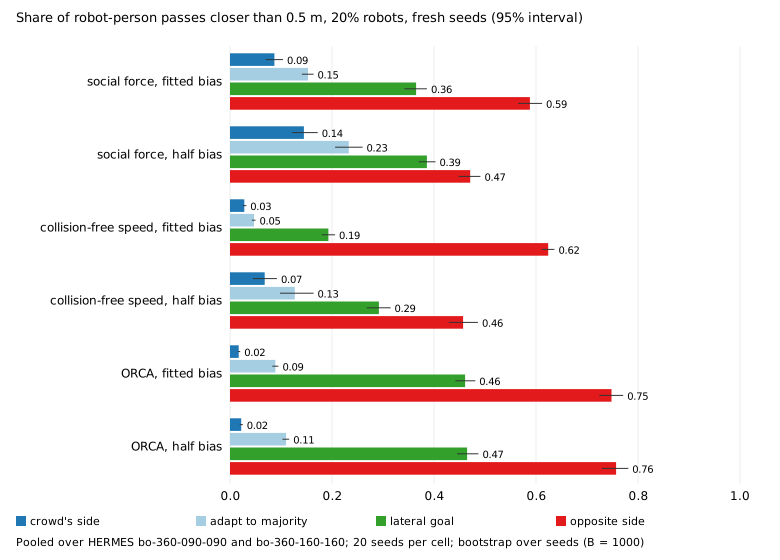
The ranking held. In all three models, at every robot share and at both bias levels, the order by close passes was the same: crowd's side, then local majority, then lateral goal, then opposite side. Kendall's tau was 1.00 in all 18 comparisons. At the fitted bias its 95% interval was [1.00, 1.00] in every cell. At half the bias, two cells at 5% robots had a lower bound of 0.67.
| 20% robots, fitted bias | Social force | Collision-free speed | ORCA |
|---|---|---|---|
| Crowd's side: passes under 0.5 m | 0.087 | 0.028 | 0.017 |
| Local majority | 0.153 | 0.047 | 0.089 |
| Lateral goal | 0.365 | 0.193 | 0.461 |
| Opposite side | 0.588 | 0.624 | 0.748 |
By delay per robot pass, the models still disagree. Tau ranged from 0.00 to 1.00 and reached 0.8 in only 2 of 9 cells. The collision-free speed model ranks a robot heading for a side exit as the cheapest, while the other two rank it third.
The caveat that matters
Halving the bias did less than planned. In social force the crowd's own-right share fell from 0.95 to 0.80, near the street value. The other two models barely moved (0.95 and 1.00). So the weaker-convention check is strong for one model only. Two more caveats: none of the models reproduces every feature of the real runs, and the robots are agents of each crowd model, so people can push them.
One thing showed up after the run that nobody predicted. In the weak-convention social-force crowd, robots keeping the crowd's side made people faster, by 1.6 s per 8 m crossing. They may act as seeds for lanes the crowd forms less well on its own. Robots also replace people here, which lowers density, so this is a lead for a later step, not a result.
What it means for a fleet operator
If a robot policy is tuned in one of these simulators to reduce close passes, the choice carries over to the others. If it is tuned to reduce delay, it may not, and any delay figure should name the crowd model behind it. Next, the programme trains a learned navigation policy (SARL) against each crowd and scores it on close passes first.
Code, data and the full log: research/society-lanes. These are simulated crowds, not people. The real-data results are kept separate in the project.
AI-assisted research: an AI agent wrote the code and text.