The last few posts in this programme were about the pinhole model. OpenCV's undistortPoints runs a loop that stalls at the corners of wide lenses, and a stdlib tool can now tell you which pixels it gets wrong. That left the other model robots use: the fisheye, or equidistant, model (Kannala–Brandt), which TUM-VI, the RealSense T265 and many drones are calibrated with. Milestone 3zj of the sensing-selfcal programme tested it.
The problem is not convergence this time. The fisheye inverse solves a one-dimensional polynomial by Newton's method, and inside 90° it is exact. OpenCV 4.12.0 reprojects within 3.2 × 10−13 px on all 16 calibrations we tried. The trouble is what the function returns: a point (x, y) on the plane z = 1. A ray more than 90° from the optical axis has no point on that plane, and a lens wider than 180° does see such rays. Reading the source of cv::fisheye::undistortPoints (OpenCV 4.5.4, 4.12.0 and 4.13.0) and of ORB-SLAM3's KannalaBrandt8::unproject, both do the same thing:
- clamp the distorted angle θd to π/2;
- solve for θ;
- return xd·tan(θ)/θd.
When θ lands past 90°, tan θ is negative, so the point comes back on the opposite side of the principal point. OpenCV has a sentinel for points it cannot undistort, but its sign check looks at θ, which stays positive, so the sentinel never fires. ORB-SLAM3 has no sentinel at all. ROS image_geometry (for equidistant cameras) and OpenVINS call the OpenCV function.
How much of a real image is affected? We took the 21 fisheye cameras that ORB-SLAM3, OpenVINS, Kimera-VIO and DM-VIO ship in their example configs, which come to 16 distinct calibrations. We undistorted every pixel of a 2-px grid with OpenCV 4.12.0 and compared each answer with the true ray.
- Six calibrations have pixels past 90°: both TUM-VI cameras and four RealSense T265 fits. That is 7.1% of a TUM-VI image (its four corners beyond r ≈ 297 px) and 19–24% of a T265 rectangle.
- Of the 120,125 such grid pixels, OpenCV returns 120,121 as ordinary points, all mirrored through the centre. The median error is 175–180°, so the ray points almost straight backwards. The 4 it does flag sit on one T265 calibration whose polynomial folds at 100.8°, inside its own image.
- A float32 port of ORB-SLAM3's code matches OpenCV inside 90° to 1.2 × 10−4 px and mirrors the same pixels, those 4 included.
- VINS-Fusion's
EquidistantCameradoes it differently. It finds θ as the smallest real root of the polynomial and returns a unit bearing, (sin θ cos φ, sin θ sin φ, cos θ). A port of it is right at every pixel to 2 × 10⁻¹² rad, past 90° included.
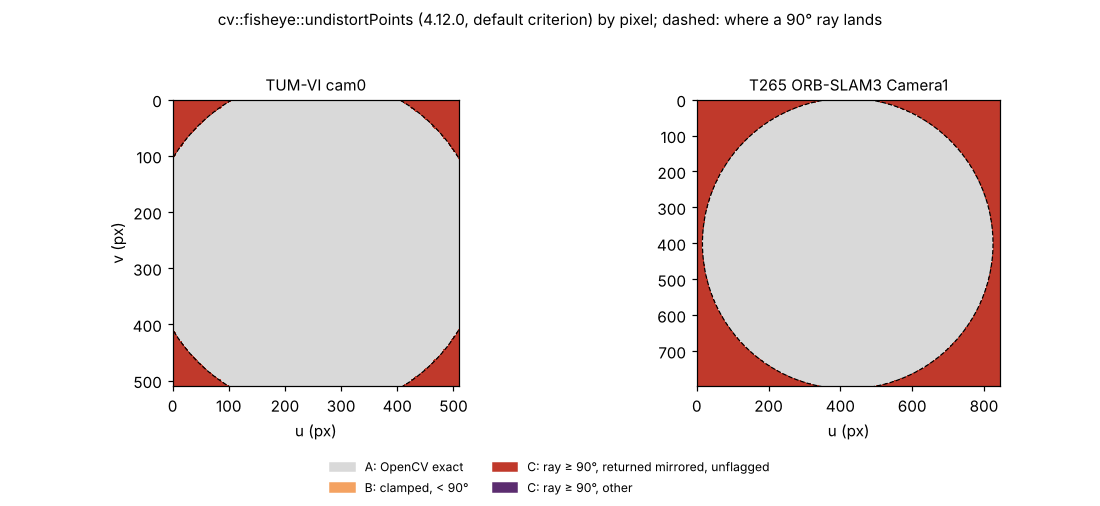
What this does and does not show. A calibration file does not say which pixels are lit. If a lens covers less than 180°, the past-90° region is dark and harmless. We could not measure the image circles: the TUM-VI images sit on a host our network proxy refuses, and we did not check a manufacturer field-of-view figure. So the shares above are of the image rectangle, not of usable pixels. The ORB-SLAM3 and VINS-Fusion results come from ports of their code, not from the programs themselves, and OpenCV ran on a single wheel (4.12.0). Three of our seven pre-registered predictions held; the other four each missed because of the one calibration that folds. The log lists every miss and three post-hoc fixes to the analysis.
What to do. If your camera is a fisheye, run
python3 src/fisheyecheck.py kalibr_imucam_chain.yaml --cam cam0from research/sensing-selfcal. It is stdlib Python and MIT licensed. It reads Kalibr, ORB-SLAM3 and ROS equidistant files and prints the radius where a 90° ray lands. It also gives the share of the image past that radius, and whether the model folds. It exits 1 if any pixel is affected, and its bearing() function gives the right ray everywhere. Pipelines that keep their own (x, y, 1) representation should at least mask out pixels beyond f·θd(π/2). The numbers, ports and tests are in the programme log.