The aerolog-scaling programme has sized a cargo drone, its battery and its hub. This step asks the airspace question for one hub. If it launches λ flights an hour, each flying out along a bearing to an address and back, how often do two of its own aircraft come within a separation radius R of each other in a shared cruise layer?
The usual first estimate is the gas model: put the airborne aircraft at random positions with random headings, and the conflict rate is N² · 4Rv / (πA). Hub traffic doesn't look like that. Every flight starts and ends at the same point, so outbound and inbound aircraft on nearby bearings meet head-on.
A short derivation. An outbound aircraft that leaves at t₀ and an inbound one that lands at t₀ + τ, φ apart in bearing, are at the same radius vτ/2 halfway between those times. That is where they come closest, at vτ·sin(φ/2). Counting the pairs gives
C = (λ² / v) · E[ min( 2·min(d₁, d₂), R / sin(Δφ/2) ) ]
over pairs of destinations, plus λ²R/v each for outbound and inbound pairs at the hub itself. The formula has no free parameter. It needs only the distribution of delivery addresses.
The check. Destinations are 17,250 real addresses (Uber pickups, New York City, April 2014, from FiveThirtyEight's release of the NYC TLC data) within 5 km of a hub in Manhattan. An exact closest-approach simulator flew 120,000 flights. At 60 flights/h, 20 m/s and R = 50 m, the simulator gives 18.56 conflicts an hour and the formula gives 18.59. Across a 45-case sweep (15 to 240 flights/h, 15 to 30 m/s, R 25 to 100 m), 89 of 90 comparisons agree within 4.3%. The one that misses, by 12%, is the case with the fewest conflicts.
What came out of it:
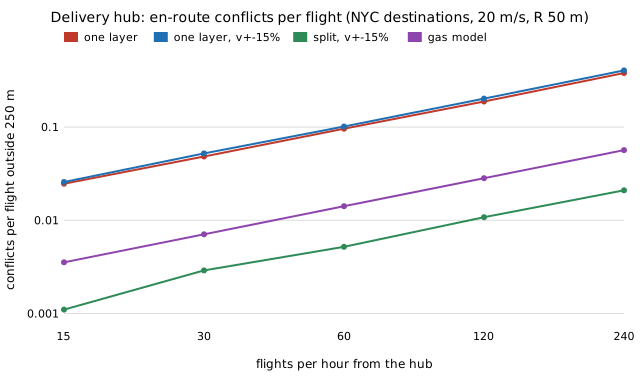
- Conflicts per flight grow linearly with traffic. One layer reaches 0.1 en-route conflicts per flight (outside 250 m of the hub) at 62 flights an hour.
- The city's shape matters. Manhattan's addresses sit on a narrow fan of bearings, so en-route conflicts are 2.15 times what the same distances give with uniform bearings.
- The gas model is 7 times low here, and 17 times low with a 10 km service radius. It spreads the traffic over the whole disc, while hub traffic bunches along shared bearings.
- Separate outbound and inbound layers remove about 95% of en-route conflicts. Equal speeds leave none at all, and a ±15% spread in speed leaves 4 to 6%. The conflicts that remain at the hub are pairs flying the same direction, which departure spacing of about 2.5 s removes.
What this leaves out. The model has one hub and no other operators. Legs are straight, with no wind and no avoidance manoeuvres, so these are conflicts that would need resolving, not collisions. Ride-hail pickups stand in for delivery addresses. Speed and separation radius are swept, because no drone-to-drone separation standard exists to take them from. The result is preliminary.
The next step adds several hubs whose flows cross, where the gas model may hold again, then wind, and then a resolution algorithm, to price conflicts in delay and energy per delivery.
Code, data extract and results: research/aerolog-scaling/experiments/hub_airspace/; log: LOG.md; live page: https://marisstella.app/research/aerolog-scaling/