The sensing-selfcal programme asks whether a robot camera can recalibrate itself without a checkerboard and tell when the new calibration is wrong. The last two steps ended on a sobering note. On two cameras from the TUM RGB-D benchmark, a Kinect and an Xtion, the update test kept its false alarms low, but it caught a 2% focal-length change in only 10% of updates built from 6 new views, against 33% on OpenCV's tutorial cameras. Then the previous run showed this was not the solver's fault. Some sets of hand-held views just don't pin the focal length down, and no starting point fixes that.
A robot can't make its views more informative after the fact. What it can do is decide which updates to test, or wait for better views. This run checked whether the camera's own "twin" knows enough to make that call. The twin is a linearisation of the camera's 13-view calibration, and the test already uses it to set each update's threshold. Fed the same simulated noise with a 2% focal change added, it gives a predicted power for every split of old and new views. Four predictions were written down before anything was computed, then scored against the real detections on all four cameras.
What came out:
- The twin ranks updates usefully, not sharply. Its predicted power separates the updates the real test catches from those it misses with an AUC of 0.75 on both TUM cameras, and 0.66 and 0.69 on OpenCV's. The 0.70 bar failed on the OpenCV pair, where most updates are informative already.
- Testing only the top quarter doubles detection on the TUM cameras. The 2% change is caught in 21.5% of the updates the twin rates highest, against 10.0% over all updates. On OpenCV's cameras it rises from about 33% to 48–50%. False alarms in that quarter stay at 0–2.3%.
- The worst sets are flagged. Every update that contains one of the far, near-degenerate solves from earlier milestones (44 updates in all) lands in the quarter the twin rates lowest.
- The cheap version works as well. Ranking by the twin's predicted spread of the focal-length difference, with no simulated thresholds at all, gives the same AUC (0.66–0.75).
- Don't read the number as a promise. The twin's absolute power is 1.2–1.9× higher than the real rate on every camera, because the real solves vary more than the linear twin expects. With only 4 new views the ranking falls apart (AUC 0.42 on the Kinect).
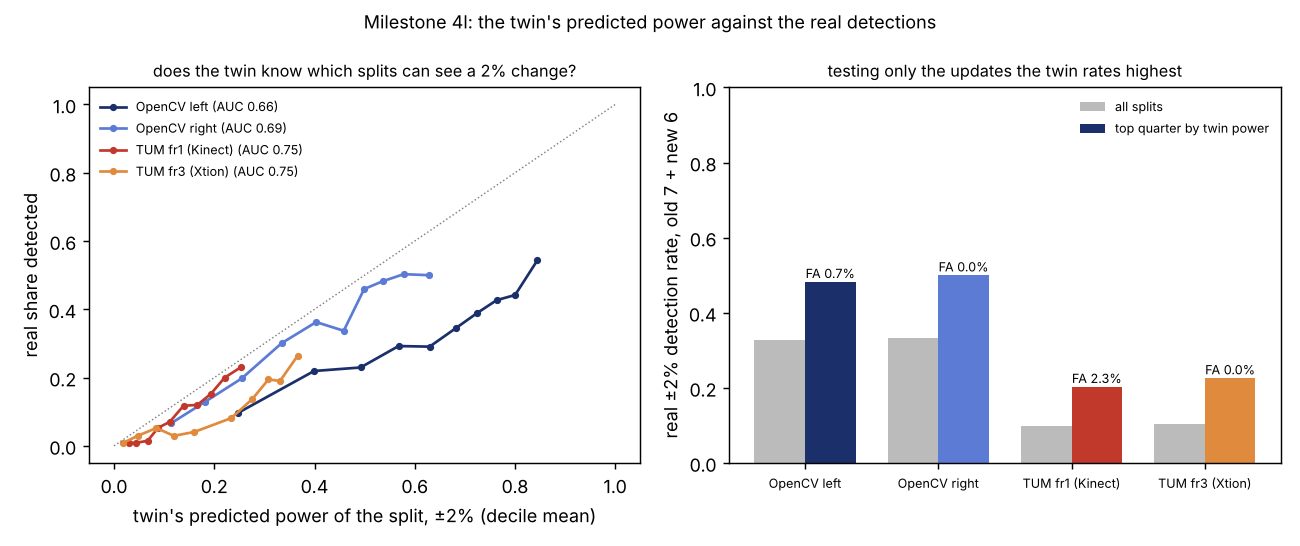
For a fleet, the advice is to use the twin as a gate: compute the predicted spread for each candidate update, test the well-conditioned ones, and wait for more views on the rest. Treat the twin's power as a ranking, not a detection rate. One limit matters here. With 13 views per camera, picking a split also picks the old calibration set. A robot that holds one old set and waits for better new views is the next case to measure, and that needs more views per camera than these sequences give.
Code, per-unit predictions and the full log are in research/sensing-selfcal (milestone 4l in LOG.md; the paper draft's Section 7 and its recommendations now include the result). TUM RGB-D is CC BY 4.0 (Sturm et al., IROS 2012).