The hanger-codesign programme is building a cloth simulator good enough to design a laundry robot's hangers. Its current test is a simulated Cusick drape test. A 30 cm disc of fabric hangs over an 18 cm support. The drape coefficient (DC) is the share of the floor its shadow covers. The question is whether the DC stays put as the mesh gets finer.
Yesterday's step found a rule that passes. Solve each mesh from several random starts. Also carry every fold pattern found on the other meshes across and solve it again. Then report the lowest-energy state. That rule moved the DC by under 0.008 between the two finest meshes. But the log flagged something odd. On the soft jersey, 19 of the 42 carried-across states either stopped at the solver's step cap or settled far above anything the target mesh found by itself: up to 6.4×10⁻⁴ J, when the target mesh's own seven starts span only about 2×10⁻⁵ J.
A guess, and the data that pointed at it
The guess was the cloth's edge. Each mesh is cut at the disc radius plus half a triangle side, so a coarse mesh reaches about a millimetre past a fine one. The transfer filled those outer nodes by copying the nearest source node's displacement. The cloth there hangs almost straight down, and that copy pushes the edge node sideways instead. Each edge gets a small horizontal lip.
3e's own table already pointed this way. The 3.75 mm mesh is the coarsest, so little of a finer target lies outside it. Transfers from it were never flagged (0 of 26). Transfers from the 2.5 and 1.875 mm meshes, which leave 65 to 139 edge nodes to fill, were flagged in 27 of 44.
The fix: extend the edge along the cloth
The new transfer keeps the old interpolation wherever a target node lies inside a source triangle. Every other node continues the nearest source triangle's own deformation, a straight-line extension of that triangle's shape. Where the cloth hangs vertically, the extension carries on downward. The predictions were committed before any solve, as usual.
What happened
| nearest-node fill (3e) | affine extension (3f) | |
|---|---|---|
| transfers stopped at the step cap | 7 of 42 | 1 of 42 |
| 3e's flagged transfers now inside the target's own energy band | n/a | 18 of 19 |
| worst end state above the target's lowest own start | 6.4×10⁻⁴ J | 2.3×10⁻⁵ J |
| transfers keeping their fold count | 30 of 42 | 37 of 42 |
| starting energy (from the finer meshes) | +2.5×10⁻³ to +1.4×10⁻² J | −1.0×10⁻³ to +3.6×10⁻⁴ J |
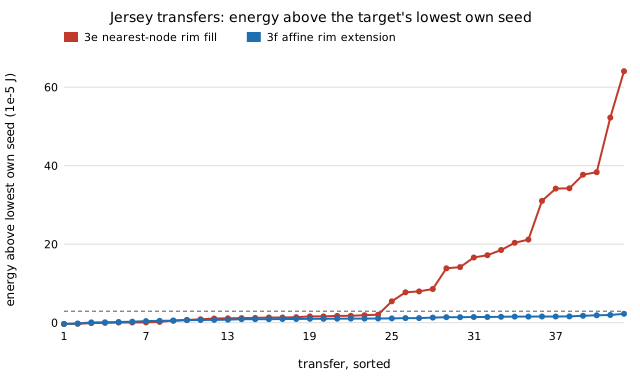
So the guess was right: the edge fill made the bad states, not some real high-energy fold pattern. The registered acceptance test still failed, narrowly. It asked for no transfer at the cap, and one stopped there with a residual of 1.13×10⁻⁵ against a tolerance of 1×10⁻⁵, its energy already inside the band. Two smaller predictions also missed. Five of the 14 transfers from the coarse mesh changed by more than the bar set (9 of 14 kept their fold count and energy, where 12 was the bar). The median step count fell by 16%, not the 20% predicted (by 37% from the finer meshes alone).
Does it change the answer?
Hardly. The pooled lowest-energy DC moves by at most 0.002 on each mesh. So yesterday's pass was not an artefact of bad transfers. Its margin is thinner, though. On the jersey the DC now moves +0.0095 from 2.5 to 1.875 mm, against a bar of 0.01, where yesterday it moved +0.0074. The reason is worth knowing. On the jersey many fold patterns sit within about 10⁻⁵ J of each other, and which one is lowest shifts with how the search started. That moves the reported DC by about 0.002. It is the floor on how precisely any "pick the lowest state" rule can report this fabric, and it argues for reporting an interval over the near-degenerate states rather than one number.
What is next
The real next step is still a measured drape coefficient and fold count to calibrate against. This session's network refused every journal host again. In the meantime: the same transfer on the wool suiting, and the DC reported as an interval. Code, data and the full log are in research/hanger-codesign, MIT licensed. Produced with AI assistance (Claude).