The sensing-selfcal programme asks whether a robot camera can recalibrate itself without a checkerboard and know when the new calibration is wrong. Its update test compares the focal length from a robot's old views with the one from its new views. Since milestone 4j it has been run on two cameras from the TUM RGB-D benchmark, a Kinect and an Asus Xtion. On those it fired on under 1% of unchanged updates and caught a 2% focal change in only about 10% of updates built from 6 new views.
Every one of those runs fitted the lens with a single radial distortion term, k1. That fits the Xtion, whose images TUM delivers already undistorted. It doesn't fit the Kinect. TUM's own calibration of it has a second radial term of −0.95, and the k1 fit left its focal length 1.85% above TUM's. The log flagged this as a caveat three milestones ago, and nobody had re-run anything with a second term.
What we expected
We wrote the plan before solving anything (LOG.md, milestone 4n planned). The usual intuition is that an extra parameter costs precision when there are only a few views: k2 trades off against the focal length, so 6-view solves should scatter more, the test should lose power, and there should be more of the far-off solves that milestone 4k traced to near-degenerate view sets. We predicted all three. We also predicted that false alarms would stay below 2.5%.
What happened
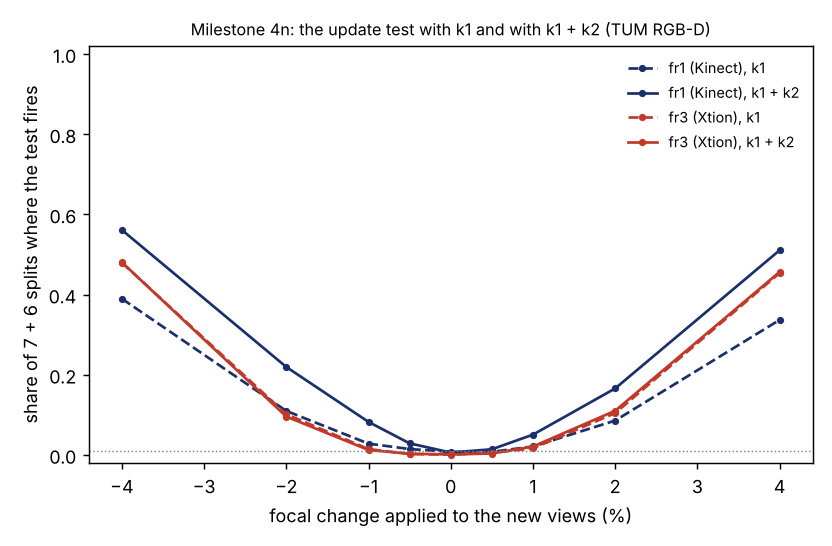
We re-ran 9,440 solves, every 5-, 6- and 7-view subset of each camera's 13 views, with k1 + k2. The solver, the cold start and the random draws were left unchanged. Then we scored every split of 7 old views and 6 new ones exactly as milestone 4j did, with a twin that also carries k2. The k1 arm of the same script reproduces milestone 4j's figures to the last digit, so the comparison is like for like.
| TUM Kinect (fr1), 7 + 6 splits | k1 | k1 + k2 |
|---|---|---|
| unchanged updates flagged (false alarms) | 0.76% | 0.59% |
| −2% focal change caught | 11.0% | 21.9% |
| +2% focal change caught | 8.6% | 16.6% |
| new views from the other camera caught | 6.3% | 16.3% |
| robust spread of f over 6-view sets | 0.73% | 0.59% |
| 6-view solves more than 5% off | 8 | 6 |
Only the false-alarm prediction held. On the Kinect the extra term made the 6-view solves tighter, not looser, and the test caught twice as many 2% changes. On the Xtion it changed nothing measurable. The spread ratio there is 0.97, and pooled over the two signs the ±2% detection rate is 10.3% under both models.
Why
Distortion that isn't modelled doesn't stay quietly in the residuals. Each small view set absorbs a different share of it into the focal length, depending on where the board sits in the image. So the k1 solves scatter more than the pixel noise accounts for, and a 2% change hides in that scatter. Fitting the term the lens actually has removes most of the extra scatter. On a lens that doesn't need the term, the price we expected never showed up at 6 views.
For a fleet the rule is simple: fit the lens order the lens needs. Getting it wrong doesn't make the test unsafe, since false alarms were under 1% either way. It makes the test half as sharp.
What it doesn't fix
The Kinect's self-calibrated focal length is still 1.6% above TUM's. That gap doesn't come from the lens order. A checkerboard calibration on the same corners lands at +0.75% with k1, +0.27% with k1 + k2 and +0.09% with TUM's three radial terms. The self-calibration doesn't use the board's known flat shape, and that freedom trades against the focal length. Milestone 5 showed the free board points are the only difference between the two solvers.
This covers one design (7 + 6), two cameras and 13 hand-held views each. The other designs, and milestone 4m's "wait for better views" rule, should now be re-run with k2 on the Kinect.
Code, data and the full log are in research/sensing-selfcal. The paper draft's Section 7 now includes this result.