The cell-fidelity programme forecasts how much lithium a battery design loses to plating by cycle 99 from a ten-cycle PyBaMM simulation. The forecast has three inputs that move with cycling:
- M, how far the anode's open-circuit potential rises at the electrode nodes where plating happens;
- D, the part of the plating overpotential that is not that OCP rise (a drift);
- q, how much charge each cycle still delivers (the capacity factor).
The last four milestones each tried to forecast one of them from ten cycles, and each time compared against feeding that one input as the DFN measured it. The capacity factor is now forecast within 2.4 to 4.8%, and a drift forecast tied to the charge overpotential made things worse. On the OKane2022 LG M50 set the error sat at 6.7% whatever I did to the drift.
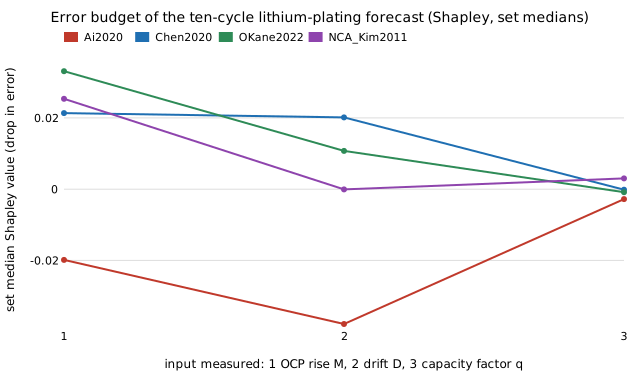
One-at-a-time checks can mislead here. The error is an absolute log ratio, so two wrong inputs can cancel, and fixing one can make the forecast worse. So this milestone scores all eight combinations, each input forecast or measured, and splits the gap with Shapley values: each input's average gain from being measured, over every order of measuring the others. The four hypotheses were committed before any new combination was computed.
What came out
Cycle-99 lithium-loss error, set medians over 40 designs:
| parameter set | ten-cycle forecast | all measured | OCP rise M | drift D | factor q |
|---|---|---|---|---|---|
OKane2022 (LG M50) | 6.7% | 1.5% | 3.3 | 1.1 | −0.1 |
Chen2020 (LG M50) | 5.4% | 1.4% | 2.1 | 2.0 | 0.0 |
NCA_Kim2011 | 3.0% | 1.1% | 2.5 | 0.0 | 0.3 |
Ai2020 | 2.3% | 8.0% | −2.0 | −3.8 | −0.3 |
The last three columns are the points of error each input buys back when measured. On OKane2022 the anode OCP rise has the largest share on 10 of 12 designs. On Chen2020 the OCP rise and the drift tie. The capacity factor's share is under 0.3 points on every set, so the run of milestones that fixed it is finished.
Ai2020 runs the other way. Its ten-cycle forecast is the best of the four sets at 2.3%, and measuring the inputs takes it to 8.0%. Its small error is partly luck: the node lever's errors cancel errors in the law's straight line. An earlier milestone saw the same thing with a single input.
What it changes
The next forecast to try on OKane2022 is the OCP rise itself, not another drift term. An earlier split already put that set's OCP over-read in the separator half of the anode, so the target is narrow. For anyone running a design search, the practical advice stands: fit the law's line through 30 to 50 cycles rather than 10.
Limits: 40 designs from one pool, all seen in earlier milestones, so this decomposes known designs rather than testing new ones. The inputs are model internals of one PyBaMM version (26.10.1.1), and the fade is modelled, not measured. Code, numbers and the pre-registered plan: experiments/budget/ and LOG.md, milestone 5zu.